
Ask a New Zealander which island is better and you will get a straight answer, delivered with total confidence, and it will depend entirely on which island they are from.
The honest answer for a first-time visitor is more useful and slightly less satisfying: they are different countries wearing the same flag, and if you have ten days or more you should see both.
The one-line version
South Island is the landscape. Mountains, fjords, glaciers, lakes the colour of antifreeze, and the emptiness that makes them feel enormous.
North Island is the culture and the strangeness. Māori heartland, geothermal country where the ground steams, most of the population, and almost all of the cities.
If you are choosing only one and you want scenery: South. If you want to understand the country: North. If you want the trip most people come home talking about: both, weighted toward the South.
The case for the South Island
This is the New Zealand of the photographs, and it earns it.
Milford Sound. A fjord walled by cliffs that rise over a kilometre straight out of dark water, with waterfalls appearing all over them after rain — which is most days, because this is one of the wettest inhabited places on earth. Arrive expecting rain and be delighted by it; a dry Milford is a less dramatic Milford.
Queenstown. A lake ringed by a mountain range called the Remarkables, which is either the laziest or the most accurate place name in the country. It is the adventure capital — bungee, skydiving, jet boats — and none of that is compulsory. The setting alone justifies the journey.
Lake Tekapo and the Mackenzie Country. Turquoise glacial lakes, the tiny stone Church of the Good Shepherd on the shore, and an International Dark Sky Reserve overhead. The night sky here is among the clearest anywhere in the world.
Dunedin. Scottish to its bones — the name is the old Gaelic for Edinburgh — with Victorian architecture, Larnach Castle on the peninsula, and the strange, spherical Moeraki Boulders up the coast.
The distances. The South Island is emptier. You drive for an hour and see three cars and a great many sheep, and that emptiness is a large part of the effect.
The case for the North Island
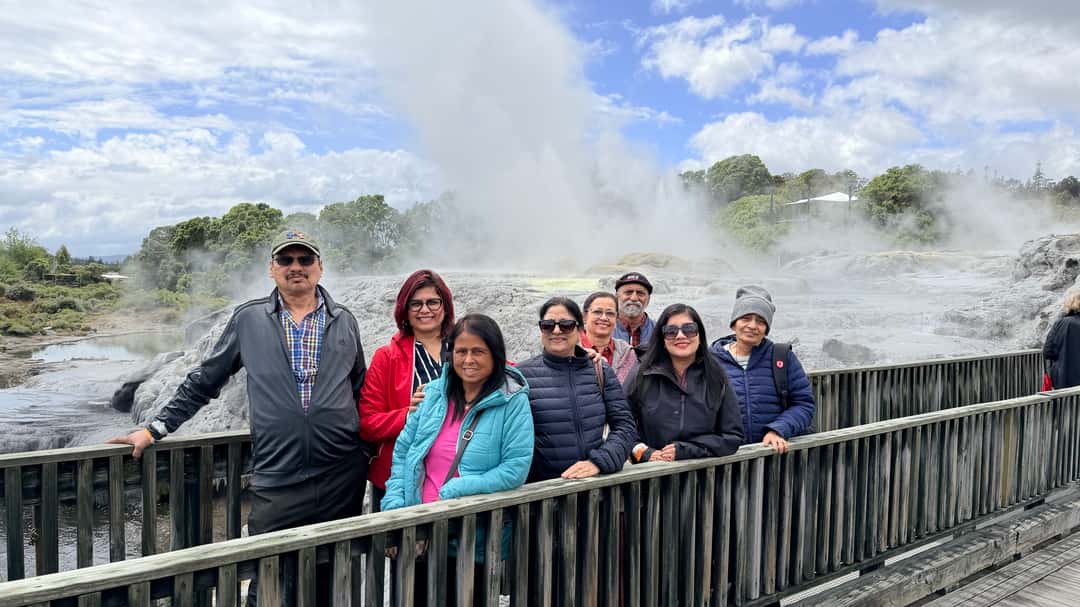
Rotorua. The single strangest place in the country. The ground steams at the roadside, mud pools boil in public parks, the Pōhutu geyser erupts several times a day, and the whole town smells faintly of sulphur — which you stop noticing within a day. It is also the heartland of Māori culture and the best place in New Zealand to be formally welcomed, fed and told the stories of the land by the people they belong to.
That last point matters. A New Zealand trip without any Māori cultural experience is a trip that has seen the scenery and missed the country.
Waitomo. Limestone caves whose ceilings are covered in the larvae of a glowworm found only in New Zealand. You float through in the dark under what looks convincingly like a galaxy.
Wellington. The capital, and a genuinely excellent small city — Te Papa museum, a coffee culture that takes itself seriously, and a harbour setting.
Auckland. Where most people land. Harbours, volcanic cones, the Sky Tower, and the largest Polynesian population of any city in the world.
How to split the days
For a trip of ten to twelve days, a rough weighting of one-third North, two-thirds South works well. The North Island's highlights are more concentrated; the South's are spread across greater distances and need more time to reach.
The crossing itself is worth building in rather than flying over. The Wellington to Picton ferry takes around three and a half hours and the final stretch through the Marlborough Sounds — a maze of drowned valleys and forested inlets — is one of the most beautiful ferry approaches anywhere.
From Picton, the Coastal Pacific train south to Christchurch runs between the Pacific on one side and the Kaikōura mountains on the other. Both of these are the sort of transit that stops being transit.
The mistake to avoid
Trying to do both islands in a week.
New Zealand looks small on a map and is roughly the length of Italy, with mountain ranges in the way. The distances are not the problem — the roads are excellent and the drives are beautiful — but they are real, and a week spread across both islands becomes a sequence of car parks.
If you have seven days, choose the South Island and do it properly. If you have ten to fourteen, do both.
Frequently asked questions
Is the North or South Island better?
South for landscape, North for culture and geothermal. Most first-time visitors weight their time toward the South.
How many days do you need for both islands?
Ten to fourteen. Below ten, pick one island.
Should I fly or take the ferry between them?
The ferry, if the schedule allows. The Marlborough Sounds approach is one of the best few hours of the trip.
When is the best time to visit New Zealand?
November to March for summer, with late spring and autumn often the sweet spot. See our slow traveller's guide to New Zealand.
Is Milford Sound worth it if it rains?
More so. Rain brings hundreds of temporary waterfalls down the cliffs.
Our New Zealand journey covers both islands over eleven days, including the Wellington–Picton ferry and the coastal train to Christchurch, next departing 14–25 November 2026. See the full itinerary.