
Georgia and Armenia are almost always sold together, and for once the packaging makes sense. They share a border, a mountain range and several thousand years of entangled history — and they are different enough from each other that seeing one without the other leaves you with half a picture.
Nine days is the shape we have settled on. Here is what fits into it — and, just as usefully, what does not.
The route
Tbilisi → Borjomi → Kazbegi → Tbilisi → across the border to Dilijan → Lake Sevan → Yerevan → Garni and Geghard.
Tbilisi is the base for the Georgian half, with a night up in the mountains at Kazbegi; then one direction south through Armenia, ending in Yerevan.
Day 1: Tbilisi
A city that should not work as well as it does. Tbilisi's old town is a collage of balconied houses, Orthodox churches, an active synagogue, a mosque, Soviet concrete, modern glass, and sulphur bathhouses with domed brick roofs sunk into the ground.
The first evening is deliberately easy: settle in, then an unhurried walk through the Old Town and a first Georgian dinner. Tbilisi is one of the most underrated food cities in this part of the world — khinkali, khachapuri, and a table that keeps arriving.
Day 2: Borjomi
West to Borjomi, a forested spa town famous across the former Soviet Union for its mineral water. Borjomi Park follows a river valley into the hills, with springs you can drink from directly, and there is an optional short jeep ride to a nearby waterfall. A green, gentle day before the mountains.
Day 3: Kazbegi and the Georgian Military Highway
The best driving day in the Caucasus. The road runs north from Tbilisi over the Jvari Pass at more than two thousand metres, with stops at the Gudauri viewpoint and the mineral springs along the way.
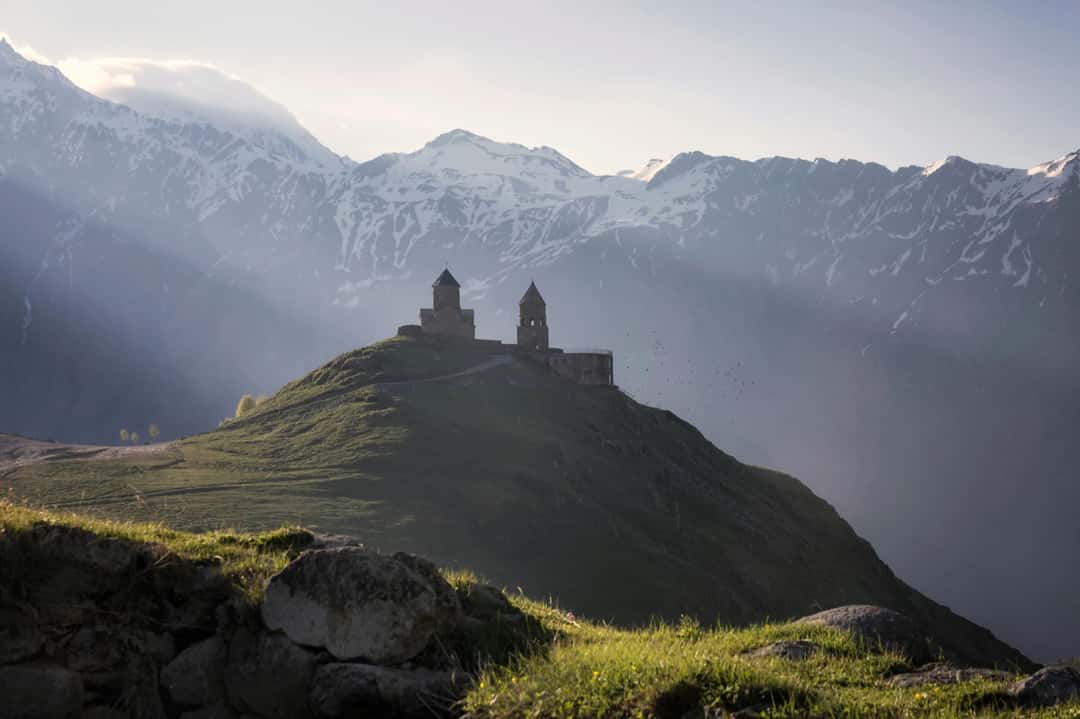
The destination is Gergeti Trinity Church — a fourteenth-century stone church standing alone on a green hilltop at 2,170 metres, with the glaciated bulk of Mount Kazbek behind it. It is the image of Georgia, it is on every cover, and it is one of the few places that genuinely exceeds its photographs.
The final approach is by four-wheel drive up a rough track; walking it is optional and takes a couple of hours uphill. We stay the night in Kazbegi, which means you see the mountain in the evening and early morning, when the day-trippers have gone.
Day 4: back to Tbilisi
Down from the mountains for a proper day in the capital: a stop at Turtle Lake, the Mtatsminda funicular to the city's highest viewpoint, the vast Chronicle of Georgia monument, a city tour, and time for a Georgian tea house or café. By now Tbilisi feels familiar, which is exactly when it becomes most enjoyable.
Day 5: south into Armenia
The border crossing, and then the landscape changes. Armenia is drier, higher, more volcanic — less green than Georgia and more austere. The exception is Dilijan, where we stay: a forested highland town of wooden balconies and an old craftsmen's quarter, sometimes called Armenia's Switzerland.
Day 6: Lake Sevan to Yerevan
Lake Sevan is one of the largest high-altitude lakes in the world, at roughly nineteen hundred metres, and so large that Armenians call it a sea. The Sevanavank monastery sits on the peninsula above it up a flight of stairs that everyone complains about and everyone climbs. Then on to Yerevan for the evening.
Day 7: Garni, the Symphony of Stones and Geghard
Garni is a first-century Greco-Roman colonnaded temple standing on a gorge edge — the only one of its kind left in the former Soviet Union, and a reminder that this was a Roman frontier.
Below it, the Symphony of Stones: a gorge wall of enormous hexagonal basalt columns, hanging like organ pipes.
Geghard is partly carved directly into the cliff face — chapels hewn out of solid rock, UNESCO-listed, with astonishing acoustics. A local lunch on the way back to Yerevan.
Days 8–9: Yerevan
One of the oldest continuously inhabited cities in the world — older than Rome — rebuilt in the twentieth century in pink volcanic tuff, which gives the whole city a warm colour in the evening. Climb the Cascade for the view, browse the Vernissage market, and meet the craftsmen who make the duduk, the apricot-wood flute whose sound is the sound of Armenia.
And Ararat. The mountain sits across the border in Turkey and dominates the Yerevan skyline — a national symbol that Armenians can see every day and cannot visit. In clear autumn air it is extraordinary.
What nine days does not cover
Kakheti. Georgia's main wine region, east of Tbilisi. We have written about Georgian wine and the qvevri method separately; adding Kakheti properly takes a full extra day.
Svaneti. Georgia's remote north-western highlands, with medieval tower houses. Spectacular, and a three-day commitment on its own.
Northern and southern Armenia's monasteries. Haghpat and Sanahin in the north, Tatev and its long cable car in the south, and Etchmiadzin near Yerevan. Each is worth seeing; together they are another three or four days.
Is nine days enough?
For the two capitals, the high Caucasus, Lake Sevan and the great sites around Yerevan: yes, comfortably. This is not a rushed nine days — Tbilisi is a base for most of the Georgian half, so you are not packing every night.
For Kakheti, Svaneti and southern Armenia as well: no. That is closer to a fortnight.
Frequently asked questions
How many days do you need for Georgia and Armenia?
Nine covers both capitals, Kazbegi, Lake Sevan and the main sites around Yerevan at a relaxed pace.
How hard is the walking?
Moderate. Monastery approaches are stepped and cobbled, and Sevanavank has a long staircase. The Gergeti walk is optional.
Is the border crossing difficult?
It is a straightforward land crossing. In a small group it is quick.
Do Indian passport holders need visas?
Yes, for both — Georgia and Armenia each offer e-visas, and holders of certain valid US, UK or Schengen visas may be exempt for Georgia. Visa fees are included in our tour price.
Which country do people prefer?
Genuinely split. Georgia tends to win on food, wine and greenery; Armenia on history, architecture and atmosphere.
When should I go?
Late September to October, or late April to early June. See our guide to the best time to visit the Caucasus.
Our next Georgia & Armenia departure runs 27 October – 4 November 2026, Tbilisi to Yerevan. See the full itinerary and inclusions.