
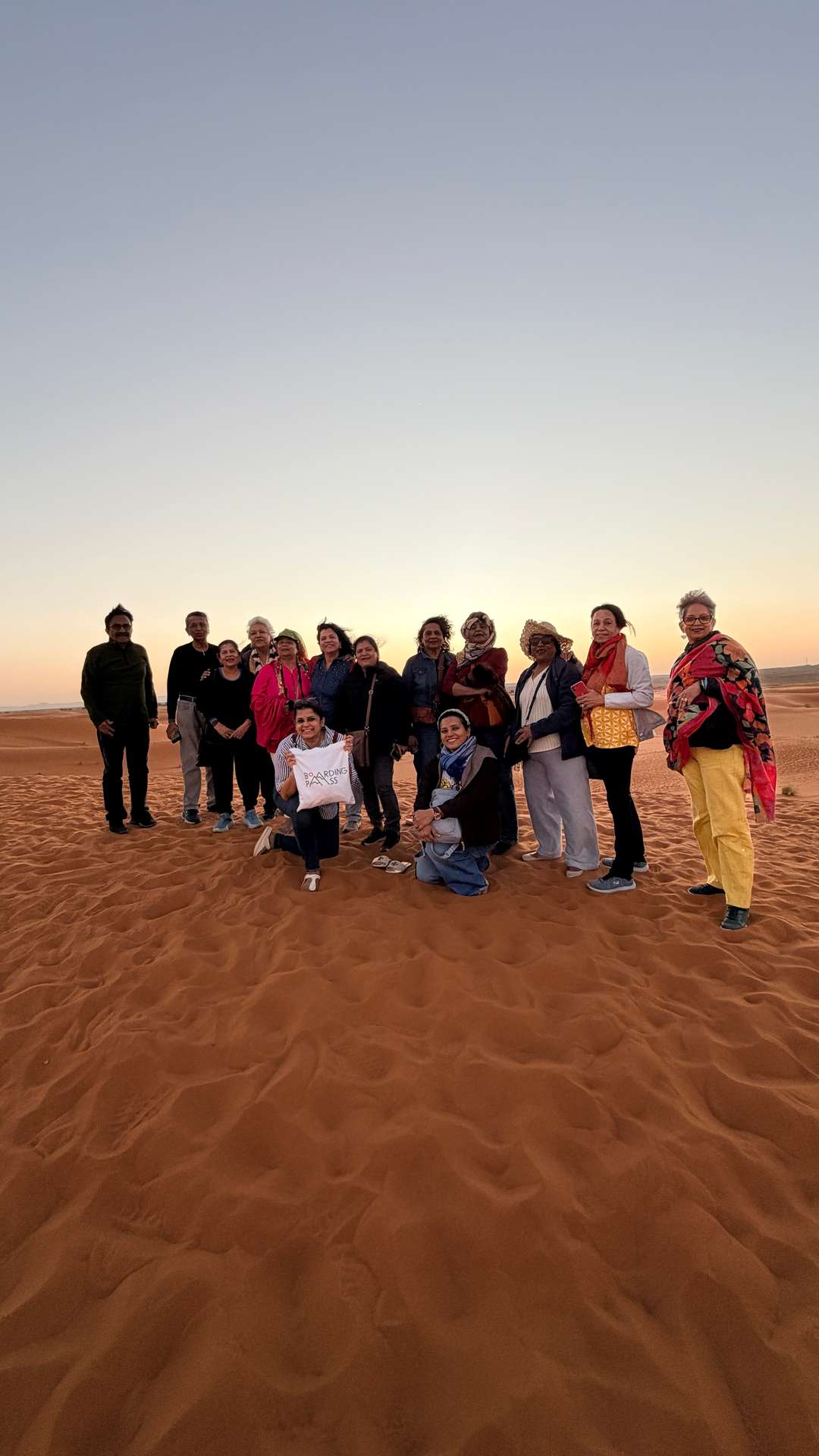
The question we are asked most often about Morocco is not about visas, or safety, or what to pack. It is some version of: what is the desert night actually like?
Underneath it sits a real worry. People have seen photographs of camps in the dunes and cannot tell whether they are looking at a luxury hotel or a sleeping bag on sand. The honest answer sits between the two, and closer to the comfortable end than most people expect.
Getting there: the camel is shorter than you think
The approach to the camp at Merzouga is by camel, and this is the part that worries people most. The ride is one to two hours, at walking pace, across dunes, timed so that you arrive around sunset.
Some practical truth: camels are tall, the mounting and dismounting is the ungainly part, and the gait is a slow rock rather than anything jarring. If you are uneasy about it, a four-wheel-drive transfer to the camp can usually be arranged instead. Nobody is made to ride, and it is a common enough choice that it needs no explaining.
What the camel gives you, if you do ride, is the arrival — coming over a dune line at low sun with the camp appearing below you. It is worth a slightly sore back the next morning.
The camp itself
Think glamping rather than camping. Our camps in the Erg Chebbi dunes have:
- Proper beds. Actual beds with frames, mattresses, sheets and heavy blankets — not bedrolls on the ground.
- Private tents. Your own tent, floored with Berber rugs, lit by lanterns.
- Hot showers. En-suite or shared depending on the camp, but running hot water either way.
- Flushing toilets. Yes, in the middle of the Sahara.
- A dining tent. Dinner is cooked and served properly — tagine, bread, soup, mint tea — and eaten at a table.
What it does not have is the thing people worry about least and notice most: reliable electricity and Wi-Fi. There is usually power for lights and a socket or two on generator or solar, and there is usually no usable internet. Most people describe this as the best part after about an hour.
The cold is real
This is the single thing travellers underestimate. The Sahara is a desert, and deserts lose their heat the moment the sun goes. In our February window, daytime in the dunes can be pleasantly warm in a shirt, and the same night will fall to five degrees, sometimes lower.
The camps provide heavy blankets and they are genuinely sufficient. But you want to have brought: a warm layer, a hat, and socks to sleep in. There is usually someone in every group who packed for the Sahara imagining only heat, and spends the evening wearing everything they own.
The evening
Dinner is at a long table, then most groups end up outside around a fire, where the camp staff — usually Berber, usually musicians whether or not that is their job description — play drums. This can go the way of a slightly awkward performance for guests, or it can turn into the evening everyone remembers for years. In a small group it is almost always the second.
Then the sky. This is the actual reason to sleep in the desert. There is no light pollution for a very long way in any direction, the air is dry, and the winter sky in particular is startling — the Milky Way as a visible band, satellites tracking across, more stars than most people from a city have seen in their lives.
Take the ten minutes to walk a short distance from the camp lanterns and let your eyes adjust properly. It is worth setting an alarm and going out again at two in the morning.
The morning
Sunrise over the dunes is early and cold and worth every second. Climb the dune behind the camp — it is harder than it looks, sand takes twice the effort of a path — and watch the light come across the Erg Chebbi. The dunes turn from grey to pink to orange in about fifteen minutes.
Then breakfast, and back out. Most people are quiet on the drive that morning.
What to pack for the desert night
- A warm layer and something for your head — the temperature drop is the whole game
- Socks for sleeping
- A head torch or your phone torch for finding your tent
- Wet wipes and lip balm — the air is extremely dry
- A small bag for the one night, since your main luggage may stay with the vehicle
- Sunglasses and sun protection for the morning glare off the sand
Who finds it difficult
Honestly: very few people. The camps are comfortable, the night is one night, and the beds are real. The travellers who struggle are those with genuine mobility limitations — sand is hard to walk on and the camel is not for everyone — and those who cannot sleep anywhere unfamiliar.
If either applies, tell us before you book. It is a far better conversation to have in advance.
Frequently asked questions
Is there a toilet at the desert camp?
Yes — flushing toilets and hot showers, either en-suite to your tent or shared depending on the camp.
Do I have to ride a camel?
No. Tell us in advance and we can usually arrange a four-wheel-drive transfer to the camp instead.
How cold does the Sahara get at night?
In our October–April window, typically 5–10°C, occasionally colder in midwinter. Heavy blankets are provided but warm layers are essential.
Is there Wi-Fi in the desert?
Generally no, and often no mobile signal either. Plan for one night offline.
How long is the camel ride?
One to two hours at walking pace, timed to reach camp around sunset.
The Sahara night sits in the middle of our eleven-day Morocco journey, next departing 8–18 February 2027. See the full itinerary, or read our guide to the best time of year to visit Morocco.