
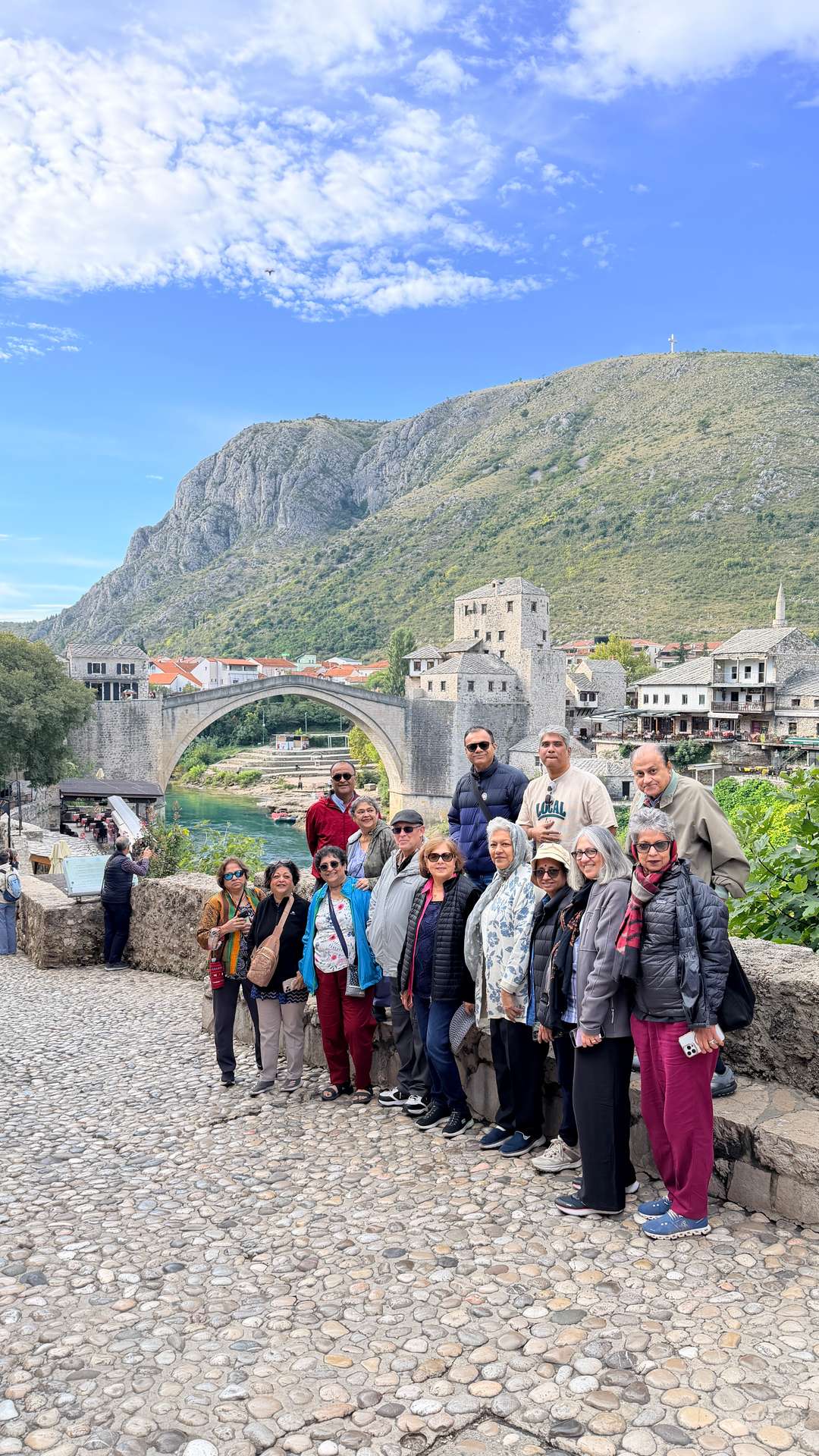
There is a stretch of road between Kotor and Budva where the Adriatic appears below you without warning — a sheet of hammered silver, framed by limestone, with a cruise ship the size of a matchbox somewhere in the middle of it. In May, that water is cool and the light is soft and green. In October, it is warmer than you expect and the light comes in low and gold from the west.
Same road. Same view. Two entirely different trips.
We run our Balkans departures in May and October, and only in May and October. This guide explains why — and how to choose between them.
The short answer
Choose May if you want long days, green hillsides, rivers at full volume and the Adriatic at its clearest. Choose October if you want warm water, autumn colour through the mountains, harvest food and noticeably fewer people at the famous stops.
Neither is a compromise. They are simply different seasons of the same extraordinary region.
May in the Balkans
Expect 20–28°C across most of the route, with cooler mornings in the mountains and generally low rainfall. The Balkans in May are green in a way that surprises people — the interior of Albania and Bosnia is lush, the rivers are running high from snowmelt, and the wildflowers are out through the Meteora valleys.
What May does best:
- Daylight. You get long evenings, which matters more than it sounds. Dinner in Sarajevo's old town while it is still light is a different experience from dinner in the dark.
- Rivers. Snowmelt means everything is running. The Neretva through Mostar is at its most dramatic.
- Green landscapes. Photographs from May look nothing like photographs from October. The hills are alive rather than golden.
- The Adriatic coast before the season. Budva and Kotor in May are pleasant towns. In August they are something else entirely.
The trade-offs: the sea is bracing if you were hoping to swim, and some higher mountain roads can still carry snow at the edges early in the month.
October in the Balkans
Expect 15–22°C, with generally low rainfall. The heat of the Balkan summer has broken but the stone has not given up its warmth, and the sea is still holding much of summer's temperature.
What October does best:
- Warm water. The Adriatic in early October is genuinely swimmable — often more comfortable than in June.
- Autumn colour. The drive through the Bosnian and Serbian interior in mid-October is one of the most beautiful road journeys in Europe.
- Harvest. This is wine season. It is also the season for everything that has just come out of the ground, which changes what appears on the table.
- Space. The summer crowds have gone. Meteora, Kotor, Mostar and the Acropolis are all measurably calmer.
The trade-offs: shorter days — you lose roughly two hours of evening light compared with May — and the first cool nights arrive in the mountains toward the end of the month.
Side by side
| May | October | |
|---|---|---|
| Temperature | 20–28°C | 15–22°C |
| Rainfall | Low | Low |
| Daylight | Long evenings | Shorter, golden |
| Landscape | Green, rivers full | Gold and russet |
| Sea temperature | Bracing | Warm |
| Crowds | Light | Light |
| Food | Spring produce | Harvest and wine |
The months we avoid, and why
It would be dishonest to write a "best time to visit" guide without saying what we deliberately skip.
July and August. The Adriatic coast in high summer is crowded and expensive, the interior gets genuinely hot, and the experience of Kotor with several cruise ships in the bay bears no resemblance to the Kotor we want you to see. A small group loses most of its advantage when every restaurant is full anyway.
November to March. Mountain passes become unreliable, many coastal towns effectively close, and a fifteen-day route across seven countries stops being pleasant.
April and September both work, and are pleasant shoulders — but May and October are the sharper versions of each.
What the season means for a multi-country route
Our Balkans journey runs fifteen days from Athens to Sofia, through Greece, North Macedonia, Albania, Montenegro, Bosnia & Herzegovina, Serbia and Bulgaria. On a route that long, weather is not a single condition — you pass through several.
The practical implication: pack layers regardless of month. A May departure can give you a warm afternoon on the Adriatic and a cold morning at Meteora in the same forty-eight hours. October does the same in reverse.
The days themselves are not strenuous — mostly city walking of four to eight kilometres, with cobblestones and some steps at the historical sites, and a stair climb at the Meteora monasteries. There are no hikes. But comfortable shoes matter more than almost anything else you pack.
Which should you choose?
If this is your first time in the region and you want it at its most photogenic and alive, go in May.
If you care more about warm evenings, food, wine and having the famous places largely to yourself, go in October.
And if you are choosing between a May departure that is open and an October one that is full — take May. This is not a region where you will feel you got the lesser season.
Frequently asked questions
Is the Balkans too hot in May?
No. May sits at 20–28°C, which is comfortable for full days of walking. The heat becomes a factor in July and August, which is why we do not run departures then.
How much walking is involved?
Moderate walking is involved during sightseeing and exploring old towns, mainly on cobblestone streets. There are some steps, particularly at the Meteora and in historic areas. The pace is comfortable and there is no strenuous hiking.
Do I need multiple visas?
Not usually. Indian passport holders need a Multi Entry - Schengen visa for Greece & Bulgaria, and holders of a valid multiple-entry Schengen visa can visit the other countries on this route without separate visas. We confirm the current rules for each country once you book.
Which month is cheaper?
They are broadly comparable. Neither is a discount season — both are chosen because they are the best time to be there.
Our next Balkans departure runs 1–15 May 2027, Athens to Sofia, seven countries in fifteen days. See the full itinerary and what's included.